Cosmo
Sacred Traditional Roles
Being in witness to these sacred and inclusive traditions has shaped my perspective in a profoundly multidimensional way. It invites me to live from a place of truth and authenticity that isn’t confined to rigid definitions, but instead rooted in a deeper, more expansive understanding of self and existence. In many Indigenous cultures, gender-diverse people are recognized as bridges between worlds—individuals who hold access to wisdom across multiple planes of experience, offering insight that can carry complexity within both cultural and spiritual realms.
I wasn’t given the stories of my own ancestors, so I’ve learned to listen inwardly—to sit in quiet and seek access points to that wisdom within myself. In doing so, I recognize that this kind of knowing is not always linear or inherited in obvious ways, but can be remembered, felt, and cultivated through presence and attention.
Understanding these traditions shifts how I see the role of gender-diverse individuals in our contemporary world. There is a deep value in the way gender-expansive people move through life—as visionaries, as translators of experience, as creators. They are, to me, artists of energy and perception, continually breaking apart limiting constructs and cutting through the noise and fragmentation of our fast-paced, electric world.
Their presence invites a kind of remembering—of wholeness, of possibility, of ways of being that are not bound by binary thinking. In that sense, their role is not only personal, but collective: to expand what we believe is possible, and to help guide culture toward something more integrated, more aware, and more alive.
The Impact of Colonialism
Our call to decolonization is often ignited by witnessing the impact of Westernized systems—how they shape the way we dress, speak, interact, spend our money, and perceive one another. These systems subtly and overtly impose expectations about gender and identity. Decolonizing our understanding begins by examining how we’ve internalized and projected these learned beliefs onto others, especially the roles and meanings we assign to gender.
This inquiry naturally deepens into questioning the belief systems we carry about identity, worth, and control—how we relate to ourselves and how we attempt to shape or manage others. Much of Western thought operates through an extractive lens, prioritizing productivity, conformity, and dominance. Interrupting these patterns, through genuine self-love and an earth-centered reverence, allows us to return to values of connection, presence, respect, and expansiveness.
Those who cultivate access to their inner world often recognize a clarity that exists beyond imposed systems. For some, like myself, direct connection to ancestral lineage may feel distant or fragmented. In that absence, I’ve learned to listen inwardly—to trust intuition, to feel into what resonates as inherently true, and to invite ancestral wisdom in ways that are personal and lived.
From there, decolonization becomes relational. It calls us back into community—with others who are also engaging this work with awareness and accountability. Through shared practice, reflection, and dialogue, we begin to unlearn what has been imposed, clarify what feels aligned and alive, and deepen our respect for cultures that have long held integrity, relationality, and wisdom at their core.
In this way, decolonizing gender is not a single act, but an ongoing process—one that reconnects us to ourselves, to each other, and to the diverse cultural histories that continue to guide more expansive ways of being.
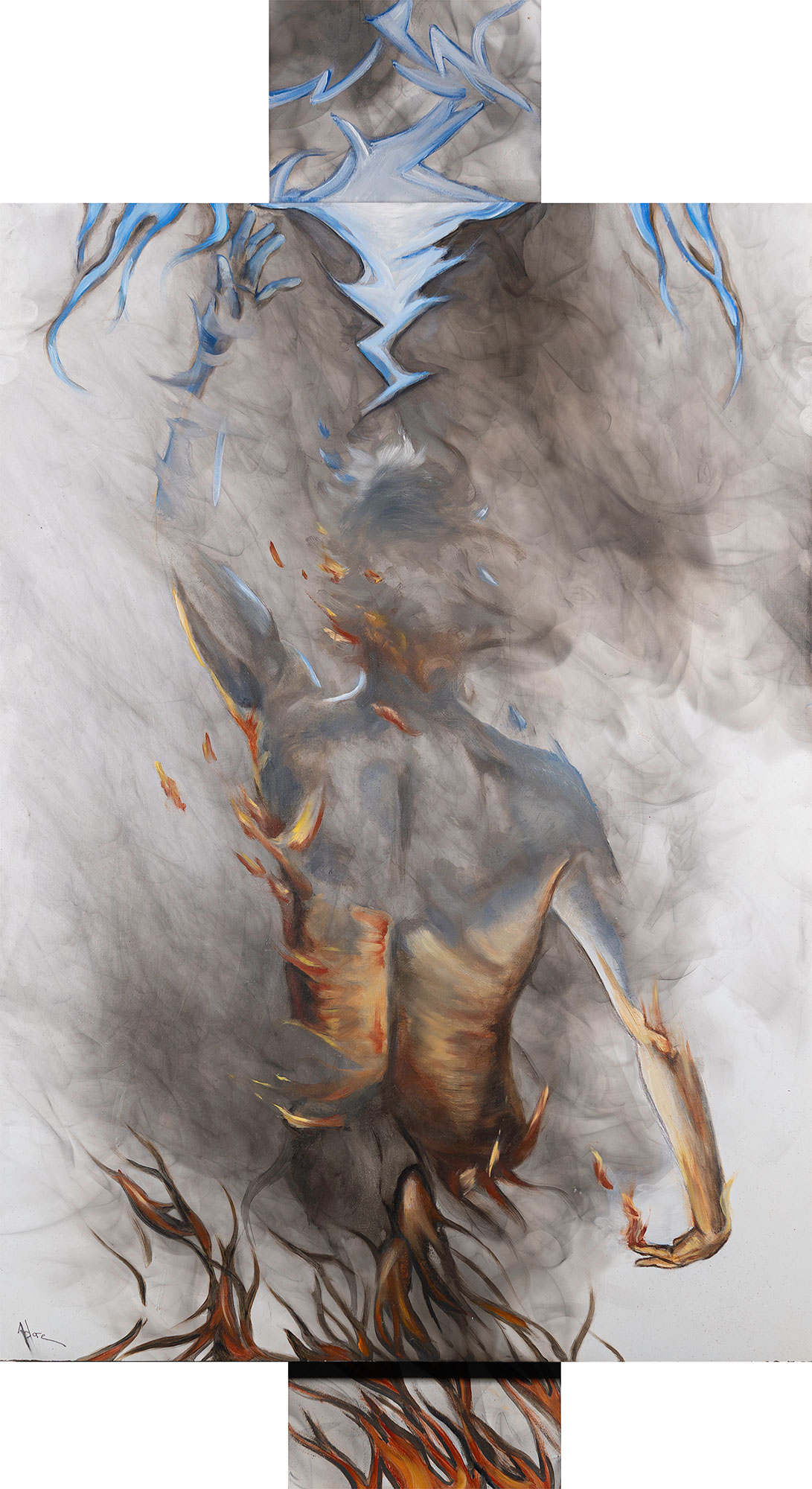
Art interpretation
The beauty of the marks are impressions of a moment of time- marks left from a guidance of the material with no control of the outcome. In becoming and truly seeing one’s self, actively living in the witness state. Its beauty in the surrender with no attachment to the outcome. And the beauty is also in the outcome. The fire feels like the dance
The marks feel like impressions of moments in time—traces left through a relationship with the material, guided but never fully controlled. In that way, the process mirrors the lived experience of becoming: navigating identity as something revealed through attention, presence, and change, rather than something fixed.
To embody an expansive identity is an act of witnessing oneself again and again in the present moment—choosing to see clearly as we shift and grow. It requires surrender: letting go of expectations about what the journey should look like, and releasing attachments to constructs and relationships that no longer align. In that space, there is an openness that allows for the raw, unfiltered beauty of becoming.
The beauty is not only in the outcome, but in the act itself—in the willingness to move without full control, to trust what is emerging. Like fire, the process is dynamic and alive. It transforms, consumes, and reveals all at once.
Fire feels like a dance. It calls others in, offering warmth and presence, while also holding the power of destruction and renewal. Being in a trans body, for me, feels similar—a dance with an inner fire of freedom, expression, and revelation. It is an intimate relationship with the cycles of transformation, where resilience is not separate from beauty, but born through it.
Reclaiming Cultural Identity
Feeling into lineage and claiming the sacred words, sounds, way it vibrates through ones self is a practice of reclamation of the wisdom of the ancestors and . Words are sacred, just like any other creation coming from an understanding of a lineage. I have western lineage and do the work to understand my importance in the world with the loss of the understanding of lineage, and can hold tremendous respect in witnessing those with indigenous
Reclaiming ancestral language is an embodied act of connection—of feeling into lineage and allowing the words, their sounds, and their vibrations to move through the self. These are not just terms or labels; they are living expressions of ancestral wisdom. Words, in this sense, are sacred. Like any creation rooted in lineage, they carry meaning, memory, and a way of understanding the world that extends far beyond translation.
For those within a lineage, there is a profound significance in speaking these words—especially when describing one’s lived experience. The sounds themselves hold history. They carry the imprint of tradition, of cosmology, of identity shaped in relationship to land, community, and spirit. To choose these words is an act of reclamation each time they are spoken—a returning, a remembering.
At the same time, many Westernized lineages carry a disconnection from this kind of ancestral knowing. For myself, there is an awareness of that absence, and a commitment to understanding my place in the world from within that reality. Part of that practice is cultivating deep respect—witnessing Indigenous people reclaiming their languages and identities, and choosing not to appropriate what is not mine to carry.
In this way, reclaiming cultural identity through language is both deeply personal and collectively significant. It restores continuity, honors ancestral presence, and affirms that identity is not only self-defined, but held within a living, relational lineage.
Political Climate of Our Time
The current political climate, which increasingly targets trans rights and access to care, creates real impacts on visibility, safety, and wellbeing—especially for Indigenous gender-diverse people whose identities are already shaped by histories of erasure. Many of these pressures stem from systems that have moved away from traditional wisdom—systems that attempt to standardize, categorize, and control rather than honor complexity and relational ways of being.
A side effect of these political and social structures is a kind of disconnection: from land, from lineage, and from ways of knowing that are rooted in wholeness. Indigenous traditions often understand identity as interconnected with nature, spirit, and community—fluid, dynamic, and sacred. In contrast, rigid infrastructures try to fit people into fixed categories, disrupting the more organic, analog ways that life actually unfolds.
Returning to a softer, more integrated place of wholeness allows for a different orientation—one grounded in kindness, care, and a recognition of our place within a greater web of life. Nature itself reflects this: it is full of variation, texture, and creative force. Power, in this sense, is not domination or control, but life force—creativity, regeneration, and authenticity. This stands in contrast to systems of power rooted in fear, extraction, and hierarchy.
To live openly as a trans or gender-diverse person in this climate is, in itself, an act of resistance and transformation. It becomes an opportunity to gently but powerfully disrupt ingrained beliefs. Each moment of visibility invites others to examine the assumptions they carry and to encounter something beyond binary thinking. In this way, identity becomes not only personal, but relational and transformative.
Remaining unapologetic does not necessarily mean constant confrontation—it can also mean rootedness. It means living in full expression, without diminishing one’s truth, while also tending to practices that sustain wellbeing: connection to food, body, land, ritual, community, and cycles of life and death. It means staying in relationship—with elders, with youth, with teachers—while discerning where to hold boundaries and where to invite growth.
Ultimately, being unapologetic is about embodying a different way of being in the world: one that does not concede to oppressive narratives, but instead models wholeness, creativity, and care. It is both a personal stance and a collective offering—supporting not only survival, but the possibility of healing and transformation for the wider community.
Community, Solidarity, and Care
Strengthening networks of solidarity and care begins with something simple and profound: showing up for one another in presence. Holding hands, looking into each other’s eyes, and recognizing the soul in one another reaffirms a shared humanity that systems of division often try to obscure. From that place of recognition, care becomes relational—not transactional—and community becomes a living practice.
We are navigating systems of healthcare and social structure that have often been shaped by fragmentation—approaches that tend to separate body, mind, and spirit rather than honor wholeness. While many of us still rely on these systems, solidarity invites us to engage them without losing sight of our full selves. It asks us to remember that healing is not only clinical—it is communal, cultural, and deeply personal.
Within a community-centered model, presence becomes medicine. When we are truly with one another, and with ourselves, we create space to transform pain rather than be defined by it. Suffering can become a point of access to insight, to illumination, to deeper understanding. In this way, care is not about eliminating all hardship, but about ensuring no one has to move through it alone.
Indigenous wisdom traditions offer important guidance here. They center relationship—with land, with ancestors, with each other, and with the more-than-human world. They remind us that we are part of an ecosystem built on reciprocity and interdependence. In such frameworks, care extends beyond the individual to the collective, and beyond the human to the living world itself.
Long before modern healthcare systems, cultures held sophisticated ways of tending to life—through teachers, healers, midwives, and knowledge keepers who understood the integration of body, mind, and spirit. Even in nature, we see forms of intelligence and care—animals instinctively seeking what restores balance. These ways of knowing still exist, though they are often obscured by the noise and pace of modern life.
To cultivate a more inclusive future, we can weave these threads together: honoring ancestral knowledge, supporting one another in tangible ways, advocating for equitable systems, and creating spaces where people are seen in their wholeness. Solidarity is not just an idea—it is an ongoing practice of care, presence, and mutual recognition that protects and uplifts the sacredness of each person, now and for generations to come.
The Language of the Self
Language, to me, is inherently limited. Words can point toward something, but they can’t fully hold the depth of lived experience. What feels more true is the space around the words—the openness, the questioning, the refusal to collapse something vast into something fixed. I want to remain in that space.
When someone asks about my gender—my genre—I might offer something like “trans masc” as a point of orientation. But it’s only that: an approximation. I am also a beauty queen, a role model to my child, a lover. Each of these identities is expansive, layered, and alive. None of them can be fully contained by language, and certainly not by a single label.
There’s something important, though, about surface tension—about the place where language meets experience. Labels can exist there: as a way to relate, to communicate, to be recognized. But beneath that surface, there is something much deeper, more fluid, and less defined.
Finding language can feel grounding at times—it can offer connection, visibility, and a sense of being understood. But intentionally rejecting or loosening attachment to labels can also be liberating. It allows for movement, for evolution, for a kind of self-knowing that isn’t dependent on external definition.
For me, it feels like living in both places at once: using words when they serve connection, and letting them fall away when they limit the fullness of what I am.
Embodiment and Joy
I exist with a deep baseline of joy. It feels like something inherent—something that’s always there. What I notice now are the moments that pull me out of that state. There used to be more fear around being fully myself, but that has shifted. Now, it’s more situational—brief moments of wondering if I’m safe walking down the street.
I move through the world in a body that is read in different ways. Sometimes I’m seen as a “soft” man, and when I wear a dress, I notice people’s gazes linger longer. I’m aware of it, but I also feel good in what I wear. There’s a kind of quiet confidence in choosing expression that feels true, regardless of how it’s received.
Gender euphoria, for me, lives in those moments of alignment—when my outer expression meets my inner sense of self. It’s in the feeling of being at home in my choices, in my movement, in how I present. It’s not always loud or dramatic; often it’s subtle, steady, and deeply affirming.
At the same time, my relationship with my body is still evolving. I carry old ideas—criticisms and shame, especially around my belly—that I can trace back to my family. In many ways, they were great teachers, showing me where those patterns live. And I’m still in the process of unlearning them.
That process, too, is part of embodiment and liberation. It’s not about arriving at perfection, but about continuing to meet myself with honesty, compassion, and curiosity. My body becomes a site of creative expression not because it is free of conditioning, but because I am learning to move through that conditioning—and still choose myself.
Chosen Family
Much of my understanding of growing into myself has come through relationship—being in connection with people from many different backgrounds and witnessing how life is lived in so many unique ways. Seeing others in relationship with their families, their cultures, and their values has expanded my sense of what is possible. It has shown me that there is no single roadmap for how a life should unfold.
Spending time in trans community has been especially transformative. It has allowed something in me to rewire—to recognize that I am not alone, and that this way of being is not only valid, but beautiful. Within these spaces, there is often a deep sense of kinship and trust, born from shared experiences. There is an unspoken understanding that many of us have moved through pain, through isolation, through darker times—and that sometimes we are still moving through them. Because of that, we develop a capacity to meet one another in those hidden places, with care and without needing to explain.
Chosen family, then, becomes a living lineage. It is something we actively create through presence, witnessing, and mutual support. It teaches us how to grow older not in isolation, but in connection—with people who see us, who reflect us, and who walk alongside us.
At the same time, I find grounding in recognizing that we are part of a much larger tapestry. Nature, to me, reflects love in a way that is often clearer than human systems. Even within the brokenness—within the impacts of colonization and the damage it has caused—there is a larger force of transformation at work. It can be painful, even devastating, but it is still part of a larger movement toward change and rebalancing.
Looking toward the future, I see the importance of bringing Indigenous and trans voices into spaces