Vijay
Navigating Public and Private Spaces
Gender-diverse individuals often have to perform a constant "inventory" of their surroundings for safety or belonging. How does the way you move through the world change depending on the space you are in, and what does it mean to find a space where you feel truly "seen" without explanation?
I am a transgender man. As a teen, I hid my face behind a thick layer of hair. Only one eye was visible. I hid my body behind large shapeless clothing. Large shoes. Young gender non-conforming people, especially of my generation, often hid both their face and body. They existed in the fog, in the poorly-lit corners. I learned to avoid people’s glances. When I walked on the street, I tried to avoid getting too close to other people. I learned to hide. I wanted to shine, but that meant pointing others’ attention to my body. As a transgender man, I learned to live my life avoiding public spaces as much as possible and protecting myself within the bounds of the most private of all spaces, my mind.
One of the most challenging things for me has been using public bathrooms. I always hesitate to go to the men’s bathroom, in case someone points at me and accuses me of intruding into the wrong space. The truth is, I have only been kicked out of women’s bathrooms. Multiple times. Despite the fact that I haven’t physically transitioned, my physical presence is often immediately recognized as a threat in the intimate personal space of women’s bathrooms. Women look at me suspiciously: sometimes confused, sometimes vocally outraged. Whenever I use a women’s bathroom, I push forward my chest so that its feminine shape may become more visible. I really dislike doing it, but I also really dislike the feeling of being perceived as a predator. I try to sneak in as fast as I can and leave as fast as possible. I have noticed that women scan everyone who goes into that private space…. In the men’s bathroom, on the opposite, no one even looks at you. Men are not on the alert in those spaces, and no one has ever looked questioningly at me there. Yet, I always feel like an intruder, an outsider.. In both spaces. So, whenever I can, I use the family or disability bathroom.
At the Gropius Bau museum in Berlin, there are dedicated gender non-conforming bathrooms. Rare spaces like that are the only spaces in the world where I have felt a clear acknowledgement that I exist and I have a place in the public realm. If physical presence is the major medium through which we participate in a public space, language is the social convention that categorizes each body that has entered that space. When I was growing up, there was no language to describe what I was. In communist Bulgaria, words didn’t exist that fit my internal reality. Therefore, I was locked into a cognitive dissonance between my body and how people talked about me, on the one hand, and my inner vision of myself, on the other. Besides hating my girl shoes and clothing, it felt wrong (and I felt slightly dissociated) when someone called me “she” or by my birth name.
I still wince inside when someone calls me "she. I am often too uncomfortable to correct them. Why? It is true that the transgender person can undergo surgery and "pass." Then he or she can live by the conventions of dualistic society and perform according to the roles society has determined as male or female. Some or many transgender people choose this path. Some embrace their post-op life and never again want to be reminded that they were transgender. I, however, haven’t transitioned yet, for multiple reasons. More importantly, I’m aware of the complex reality within me that goes beyond the limiting options that language provides. After a lifetime of experiences in the body I have, neither “he” nor “she” nor even “they” can fittingly reflect my inner reality (though I do prefer the pronoun "he," I find it limiting).
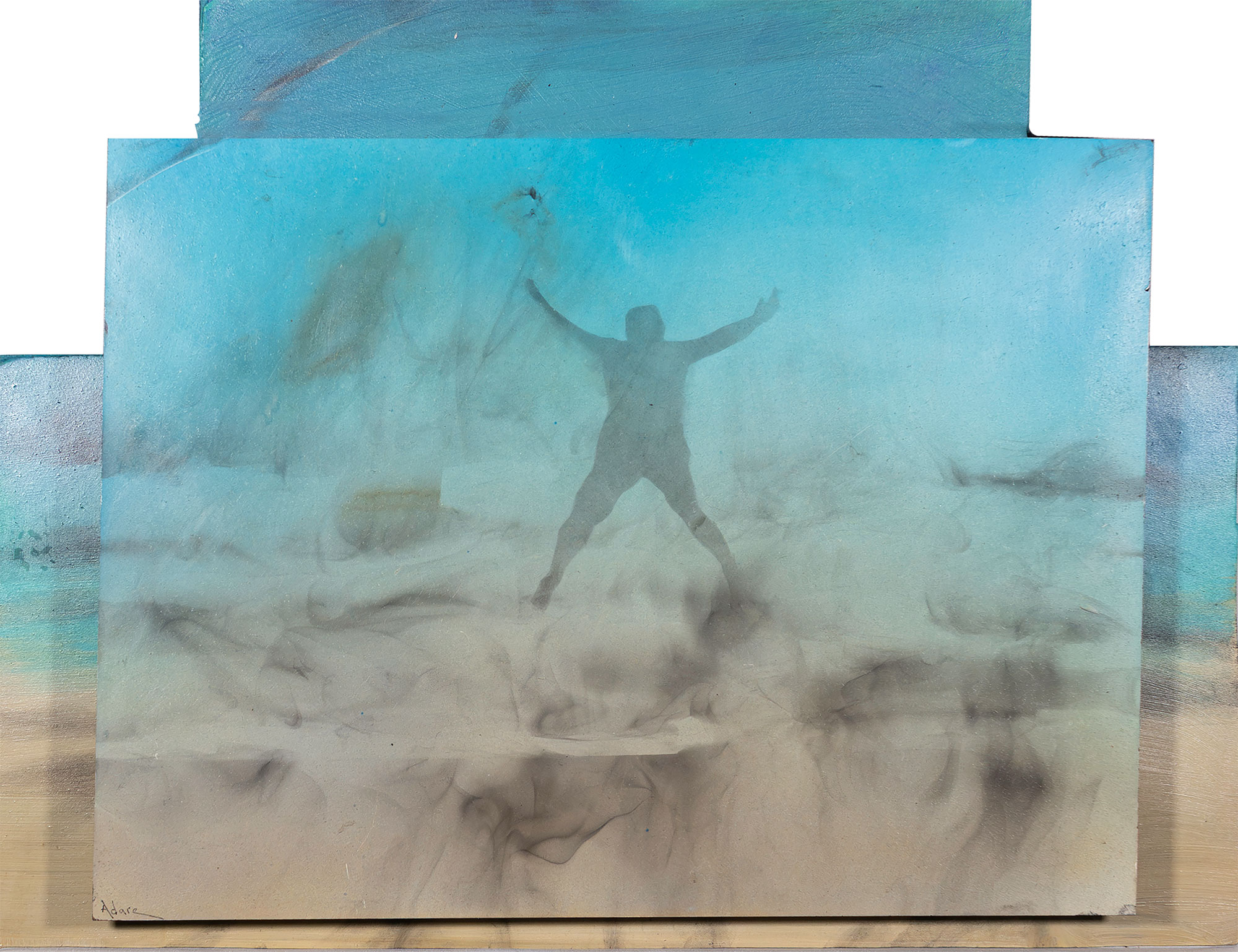
I spent my life with the strong feeling that there is no space for me in the world. After 40 years, I have made the choice to exist. That could only happen if I accept my right to be a part of the world. Just as I am. It’s an inner revolution first. I am still in the middle of this process, but I like to think that I am making steps each day. Each day, I try to defy the thick gravity of the fog and jump towards the blue sky, towards the sun. There, I find the lightness of just being myself. There, I give permission to myself to just be, and I reject all other authorities. If someone denies my existence, I could still gently hold space for myself. I could still accept the world as it is and claim my space in it. I could focus on the many good things in my life and on the loving people in my life. Perhaps life is a choice, no matter who you are.
Because I am aware that I transgress the boundaries of social conventions, I still sometimes question my right to be who I am, a transgender man. I still find myself afraid of disrupting the patriarchal model, which I have also internalized. It is a battle within myself, with myself first and foremost. It’s a battle of inner emancipation from the narrow models of who you can be. After a lifetime in the fog, my choice to claim my identity necessitated difficult external ruptures, including the decision not to communicate with my parents.
Above the fog. Still a dark figure. Still sometimes shapeless, still sometimes in hiding. But now, more often in the light.